 Emergency food isn’t the same as your parent’s bomb shelter supplies. We’ve come a long way in understanding essential nutrition, proper food packing science and ways of prolonging food sources.
Readers of this website know that I am always challenging them to get foodstuffs in order because we never know when the next emergency will hit or how close for that matter. I thought I would simplify things and provide you with a shopping list to start your emergency food supplies. Print this list out and give it to family members or friends who can begin their own preparedness efforts.
The shopping list below was based on the food amounts needed for 1 person for a 6 month period from the Latter Day Saints food storage calculator. To add more family members, find a food storage calculator to see how much food your family needs. These foods are easy to find at supermarkets and most of these items have a long storage lifetime if properly stored. Buying these food items now would be a good investment on your part, as global food prices are hitting record highs.
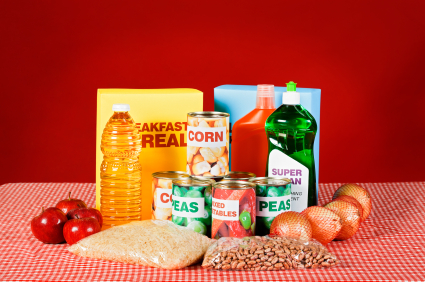
First Time Shopping List for an Emergency Food Supply:
1. 10 lbs. of white or wheat flour (both would be better. Remember the Prepper Golden Rule: 1 is none and 2 is 1). Those of you who have wheat allergies, click here for alternatives.
2. 10 lbs. of corn meal
3. 5 lbs. of oats
4. 20 lbs of rice (white rice stores better than brown rice)
5. 12 lbs of pasta
6. 20 lbs of beans (pinto beans are usually packed in heavier quantities)
7. 5 lbs of mixed beans (lentils, mixed bean soup, black beans, etc)
8. 5 lbs of sugar
9. 2 lbs of salt (this is a multipurpose prep item, click here for more information).
10. 1 gallon of cooking oil
11. 2 large containers of peanut butter
12. 5 lbs of powdered milk
13. 1 lb of baking soda
14. 1 lb of baking powder
15. .5 lbs of yeast
16. 1 gallon of vinegar
17. 1 gallon of drinking water per day (*I would round up here. You can never have too much water)
18. 1 gallon of bleach for sanitation and treating water
Don’t Forget To Add More Nutrition!
The above-listed items are a very basic food supply. A person needs to add vitamins and nutrients to this emergency diet to maintain bodily functions and overall health. To add a variety to this emergency diet, you can begin accumulating different types of canned goods or can your own. Concentrate your efforts on goods that provide you with loads of vitamins and proteins. Canned goods such as canned meats, canned beans, soups, canned vegetables, and fruits. And remember to buy foods that your family normally eats.
Another way to include essential vitamins and nutrients to your food supply is to stock up on sprouting seeds. In an article I wrote about sprouting, I mention that these tiny sprouts may be minuscule in size, but they are jam-packed with essential vitamins.
Once a seed has germinated, it begins to sprout. Within these sprouts contains vitamins A, B, C and E, and K, as well as, Calcium, Potassium, Zinc, Chlorophyll, amino acids, and up to 35% protein. Inside these small biogenic (living) foods lies essential nutrients and vitamins that can assist in providing a good portion one’s daily requirement of nutrients. Sprouts can grow anywhere, during any season, and require minimal work.
In addition to food, many preppers also buy powdered drink mixes, tea bags, and coffee to add a variety to just drinking water.
Emergencies arise all the time. Sometimes they affect a large population and sometimes they are felt on a personal level and only affect one household. That being said, start with a simple investment of food supplies and add an extra 10% of your monthly budget toward your food storage. Remember, you are investing in your peace of mind. If an unforeseen emergency occurs, your stress level will not be as heightened because you know that you are prepared for it.
Have you heard about Gossner Foods UHT Milk products? UHT stands for “ultra high temperature” pasteurization. These milk products are then packaged in 1 quart packages with a 9 month shelve life without refrigeration. Once you open it, you must refrigerate the unused portion, once open it’s good for fourteen days. Great for emergencies, I get it on the west coast from the “Dollar Store”….the only distributor in California. I use it for baking, puddings, etc., this way I’m always rolling my stock and have it for the unknown if needed! I wrote to the manufacturer and asked about the shelve life. they stated that the use by date is not the limit of the product, I’ll find the email reply and post it here later. These products are available in Whole, 2%, white, chocolate and other flavors. This is the only way I know of to have whole milk products 9 months into a disaster! Check it out: http://www.grossner.com , Stay safe, stay ready!
“Dollar Tree” stores in Fresno have UHT milk. Look in the larger stores.
Sometimes with refrigerated milk. Varieties vary. May have to visit several stores.
“Gossner” brand whole and 2%, also “Parmalat” brand 1%.
Plain UHT soy milk is always in stock at Dollar Tree and also “99 Cent Store” if that is your choice.
Have you found this milk lately at Dollar Tree? Not at my local store but will check when I go out of town. See that this post was written two years also.
This is terrific advice. We’ve accumulated around one year’s worth. Lately, we’ve focused some effort on hiding the food storage. For months we proudly displayed it on our overhead kitchen ledges (for lack of anywhere else to put it).
Lately though, with more and more talk of state agencies considering legislation that would enable the authorities to take over private buildings, medical supplies, food supplies, etc in the time of crisis, we’ve decided to start making our stash “disappear.”
Just a thought.
Could you give some examples of how and where a stockpile could disappear.
Some food could be stored under the beds, you could build a “false wall” in another room andhave the food storage there, especially if it looked like a library wall, use the attic, the barn for dry goods in metal barrels( most people wouldn’t think to look in a barn forpeople food.
I lost mine in a flood on top of Mt everest.
Wanted to make a comment about sugar. You have listed 5lbs of sugar. When people make recipes that use sugar not all recipes require the amount of sugar it asks for. Many times you can cut the sugar in half and it’ll be just as good if not better. I am diabetic and found by simply cutting the amount of sugar in half or to only 1/3 the asking amount some recipes are just as good. I have actually got away from the taste of sugar so a little tastes like alot to me. Its also better for you. I say this due to the issues of diabetes today. Try small batches with much less sugar. After a few times you may find less sugar is better. Some recipes use the sugar to fluff or make the final product look/act a certain way. Those may need the sugar or you may find substitutes for it. If you must use sugar go for the least processed kinds because they have more nutritional value and not just taste.
Hi. Fantastic Website. Thanks for all the helpful information & links. What we would all find very helpful would be some basic cooking recipies to go along with the Suggested list of Emergancy Food supply list. Thanks again & keep up the great work.
Cheers
Peter (Melbourne, Australia)
I`v started prepping and to have a list like this means alot to me.Well i`m of to wall mart
I get a chuckle every time I see a prep list that says you need 1 or even 2 gallons of water per person per day AND THEN their food lists are ALL DRIED FOODS that need water to be used. Dried milk (need water), drink mix (need water) dried beans and rice (need water), pasta, flour for bread, PEANUT BUTTER, etc….. You need A LOT more water than you think.
@ Tommy – I completely agree with you that is why I usually advise people to “round up” or “at a minimum store this amount of water.“. The bottom line folks, is water is your #1 prep. If you do not have access to clean water, within 3 days you could die. Thanks, Tommy for reminding us how important it is to store lots of water as well as having multiple ways to clean your water (purification tablets, water filters and/or water filtration systems such as the Berkey Water Filter).
Tess
My personal feelings and thoughts are we all must be prepared for any type of natural and/or manmade disasters – our weather patterns are getting crazier all the time; the real facts and possibility of a New Madrid Fault disaster, San Andreas Fault disaster, EMP disasters; the threat of a nuclear attack – don’t panic and get too paranoid, but at the same time be ever mindful of the reality of these things we could face in our communities and across the nation – or even global disaster – with the 2012 midwestern states drought on the corn crops alone, this nation is going to face another 10-15 percent increase in the cost of groceries alone in 2013 because of stocks based on futures – future crops and production, distribution for 2013. Corn is used in some manner in just about everything edible and even in some pet foods. This nation could easily be put into a position where we could be thrown back into the 19th century -don’t even want to think about it – but we MUST be prepared and stock and hoard, if you will, certain food items and water – find a way to make a pantry or increase the size of an existing one – somewhere where foods can be kept and stored for at least one year in waterproof, mold-proof, bug proof containers – preferably in 5 gallon buckets – go online and check out websites for disaster preparedness and disaster food storage and containers – get creative – you will have to think things through for yourself and your family; especially the elderly and infants, toddlers – and get all the ammo you can get too!!!
food grade diatomaceous earth is great to mix with grains for storage. Bugs stay away or get cut up if they invade plus it is safe if eaten, even good for you.
take a look around you and think about how you would survive say, if the New Madrid Fault or San Andreas faults were to erupt causing massive death and destruction – how would you survive if you lived in the states that would be affected by this massive eruption – you’d be in a real fix!!!! one that you couldn’t get out of – after working in the midwest this past year and the torrent of tornadoes, it is quite apparent one needs to be prepared for just about anything – we are purchasing the 5 gallon food grade plastic buckets with gamma seals and have created a basement locked pantry for food and supplies storage and yes, ammo too. we went to dollar tree and started loading up on pasta noodles, spaghetti noodles, egg noodles, clorox, lysol bathroom cleaner, napkins, straws, matches, canned Campbell’s soups, spices, sea salt. We have gone to WalMart and purchased one of each of the extra large or gallon size foods such as cooking oil, yellow and white vinegar, 15-20 pound bags of rice, flour, sugar, xl mustard, ketchup, bbq sauce, 4 pack brownie mix, xl hot chocolate, lemonade mixes, pickles, chili, beef ravioli, 24 roll packs of toilet paper – can’t do without that folks – just to name a few – it takes a wile to accumulate these things, but it is worth it – we also have started using fooddehydrators for our garden-grown foods such as green peppers, tomatoes, etc. and we are learning how to can foods as well –
Dried beans and anything that requires boiling will not help anyone in a hurricane. I really wish more people would consider those of us stuck in a hurricane who cannot heat water. You can’t go outside and fire up your grill. Because most of us in hurricane zones are in the far south, we don’t have a need for fireplaces and few of us have one.
Hello Magnolia South,
Have you considered preparing the beans ahead of time (void of oils and meats) and dehydrating it? That way, all you have to do is add boiling water to the beans and allow them to rehydrate. This is what I did when we lived in hurricane alley and ended up dehydrated many of my meals an storing them in ziploc or Mylar bags. Here’s a link to some recipes that I have used.
https://readynutrition.com/resources/10-dehydrator-meals-for-your-prepper-pantry_28122013/
Hope this helps!
Tess
Hope this helps.
How do you boil water in the rain? You can’t do it in the house! There is no electricity and you cannot use a camp stove in the house.
Oh and no offense, but there is no such thing as “hurricane alley”. There is tornado alley and this would work fine there. I used to live there as well. I think you are not understanding what a hurricane is.
You certainly CAN use a camping stove in the house. Open a few windows! Particularly in the south it’s hot enough to want them open anyway with the power out, or not.